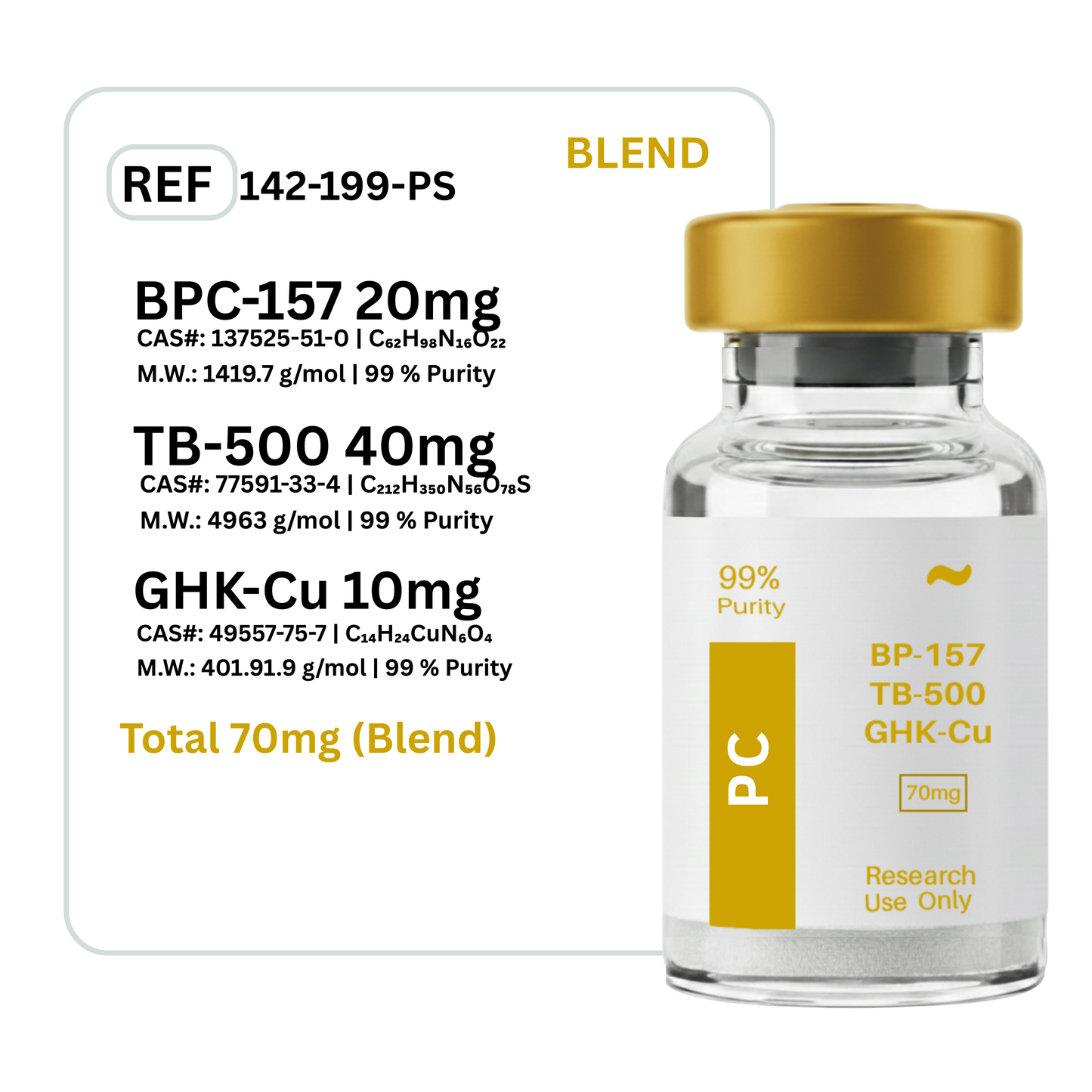
BPC-157 + TB-500 + GHK-Cu
This batch of BPC-157 + TB-500 + GHK-Cu Peptide Blend has been third party lab tested and verified for quality.
Contents: BPC-157, TB-500, GHK-Cu
Form: Powder
Purity: 99.3%
Couldn't load pickup availability
Free Reconstitution Solution automatically added to your cart with each order.
This product is Made, Tested & Shipped From Canada.
Shipping & Delivery
We are committed to delivering fast, reliable, and transparent shipping for all orders. Please review our policy below for details on delivery times, tracking, and what to expect with every purchase.
View Full Shipping Policy
Verified+

Cellular Rejuvenation Research Model: Investigating Inflammaging Reversal
1. Introduction and Project Focus
This document outlines the Cellular Rejuvenation Research Model, a focused study designed to investigate the reversal of age-related cellular decline, particularly the phenomenon of "Inflammaging." The core objective is to utilize and assess the regenerative and anti-inflammatory properties of specific compounds, namely TB-500 and GHK-Cu, in an in vitro setting. This model serves as a foundational platform for advancing longevity and regenerative medicine research.
The project is structured to generate robust, reproducible data on how targeted molecular interventions can modify gene expression, reduce chronic inflammation, and restore youthful cellular functions. The ultimate goal is to identify and validate pathways that can effectively mitigate the cumulative damage caused by the aging process at a cellular level.
2. Scientific Background: The Pillars of Cellular Aging
Cellular aging is a complex, multifactorial process. Our research model specifically targets three major, interconnected hallmarks of aging where TB-500 and GHK-Cu are hypothesized to confer significant benefits.
2.1. Inflammaging
Inflammaging refers to the chronic, low-grade, sterile inflammation that increases with age and is a key driver of various age-related pathologies.
- Mechanism: Senescent cells accumulate over time and secrete a collection of pro-inflammatory cytokines, chemokines, and proteases known as the Senescence-Associated Secretory Phenotype (SASP). This creates a perpetual state of inflammation.
- Targeting Inflammaging with TB-500: TB-500, a synthetic version of the naturally occurring peptide Thymosin Beta-4, is hypothesized to target the chronic, low-grade inflammation associated with aging via gene modulation. Specific focus will be placed on the downregulation of NF-$\kappa$B and the modulation of key SASP factors (e.g., IL-6, IL-1$\beta$, and TNF-$\alpha$).
2.2. DNA Repair and Genomic Instability
Genomic instability, the accumulation of DNA damage and errors over time, is a primary driver of cellular senescence. The efficiency of DNA repair mechanisms declines with age, contributing directly to cellular decline.
- Molecular Focus: TB-500 and GHK-Cu are studied for their ability to modify gene expression patterns back to a more "youthful" regenerative state. This involves assessing the expression of key DNA repair enzymes (e.g., PARP-1, DNA ligase IV) and telomere maintenance factors (e.g., telomerase reverse transcriptase, TERT).
- Hypothesis: Intervention with the peptides will enhance the intrinsic capacity of aged cells to repair oxidative and double-strand DNA breaks.
2.3. Oxidative Defense and Mitochondrial Dysfunction
Oxidative stress, the imbalance between the production of reactive oxygen species (ROS) and the cell's ability to detoxify them, is strongly correlated with aging. The primary cellular source of ROS is the mitochondrion.
- Restoration Pathway: The model investigates how GHK-Cu restores the antioxidant capacity of aged cells via copper-dependent enzyme activation. Copper is a critical cofactor for Superoxide Dismutase (SOD), specifically Cu/Zn-SOD.
- Expected Outcome: Increased expression and activity of antioxidant enzymes (SOD, Catalase, Glutathione Peroxidase) leading to reduced intracellular ROS levels and improved mitochondrial health markers (e.g., mitochondrial membrane potential, ATP production).
3. Usage: Applications of the Research Model
The Cellular Rejuvenation Research Model is designed for use in various high-throughput and detailed experimental formats:
- In Vitro Senescence Assays: Using primary human cells (e.g., human dermal fibroblasts, HDFs; mesenchymal stem cells, MSCs) induced into replicative or stress-induced senescence.
- Longevity Models: Applicable to established model organisms and cellular lines for initial screening of longevity-promoting effects.
- Drug/Peptide Screening: Provides a benchmark for comparing the efficacy of novel anti-aging compounds against established controls (TB-500 and GHK-Cu).
- Mechanism of Action Studies: Used to pinpoint the exact molecular targets and signaling pathways (e.g., Akt/PKB, Wnt/$\beta$-catenin) modulated by the therapeutic peptides.
4. Materials and Methods
4.1. Cell Culture and Senescence Induction
Cell Type
Senescence Induction Method
Primary Readout
Human Dermal Fibroblasts (HDFs)
Replicative Senescence (passaging until arrest)
$\beta$-Galactosidase Staining
Human Endothelial Cells (HUVECs)
Stress-Induced Senescence (exposure to H$_2$O$_2$ or ionizing radiation)
SASP Marker Expression
Progeria Patient-Derived Fibroblasts
Genetic Senescence Model
Lamin A/C integrity
4.2. Peptide Treatment Protocols
Peptide solutions will be prepared fresh in sterile phosphate-buffered saline (PBS) and filtered.
Peptide
Stock Concentration
Working Concentration Range
Duration of Treatment
TB-500 (Thymosin Beta-4)
10 mg/mL
1 ng/mL to 10 $\mu$g/mL
24 hours to 7 days
GHK-Cu (Copper Peptide)
5 mg/mL
100 nM to 1 $\mu$M
48 hours to 14 days
4.3. Key Experimental Assays
The following table summarizes the assays central to the model's focus areas:
Focus Area
Assay Method
Molecular/Cellular Target
Inflammaging
Quantitative Real-Time PCR (qPCR)
IL-6, IL-1$\beta$, TNF-$\alpha$, NF-$\kappa$B
Inflammaging
ELISA/Luminex
Secreted cytokine levels in culture media
DNA Repair
Immunofluorescence
$\gamma$H2AX foci formation and resolution (DNA damage marker)
DNA Repair
Western Blot
Expression of PARP-1 and DNA Ligase IV
Oxidative Defense
Fluorometric Assays
Intracellular ROS (DCFDA), Glutathione (GSH/GSSG ratio)
Oxidative Defense
Spectrophotometric Assays
Activity of SOD and Catalase enzymes
General Viability
MTT/Cell Counting Kit-8 (CCK-8)
Cell metabolic activity and proliferation rate
5. Inflammaging Reversal: Detailed Methodology
5.1. Senescence-Associated $\beta$-Galactosidase (SA-$\beta$-Gal) Staining
The gold standard for identifying senescent cells. This assay measures lysosomal $\beta$-galactosidase activity at pH 6.0.
- Procedure: Senescent cells will be fixed and stained with X-Gal solution. The percentage of blue-stained cells (SA-$\beta$-Gal positive) will be quantified microscopically across five randomly selected fields per well.
- Data Analysis: Comparison of the percentage of SA-$\beta$-Gal positive cells in untreated senescent cells versus peptide-treated senescent cells. A significant reduction in staining indicates a reversal of the senescent phenotype.
5.2. Gene Expression Profiling of SASP
The full molecular fingerprint of SASP is evaluated using qPCR array panels.
- Panel Genes: Key pro-inflammatory (IL-6, IL-8, IL-1$\beta$, COX-2), angiogenic (VEGF), and remodeling (MMP-1, MMP-3) factors.
- Procedure: Total RNA extraction from treated and untreated cells. cDNA synthesis followed by qPCR using validated primers.
- Primary Data: Fold-change in gene expression relative to young, healthy control cells. Successful intervention will show expression patterns shifting away from the senescent state towards the young control.
5.3. Secreted Cytokine Quantification
While gene expression is crucial, the actual output of inflammatory factors is measured via ELISA or Luminex multiplex assays on conditioned media.
- Target Cytokines: Focus on secreted IL-6, TNF-$\alpha$, and MCP-1 (Monocyte Chemoattractant Protein-1).
- Significance: This provides direct evidence of the peptides' ability to suppress the inflammatory secretome, which is the mechanism by which senescent cells induce dysfunction in neighboring healthy cells.
6. DNA Repair and Genomic Stability Assessment
6.1. Quantification of DNA Damage Foci
Double-strand breaks (DSBs) are the most critical form of DNA damage and are marked by the phosphorylation of histone H2AX ($\gamma$H2AX).
- Assay: Immunofluorescence microscopy. Cells are stained for $\gamma$H2AX and counterstained with DAPI (for nucleus visualization).
- Readout: The number of $\gamma$H2AX foci per nucleus. An increase in this number signifies high damage load, while a rapid decrease following treatment (especially post-stress induction) indicates enhanced repair kinetics.
6.2. Telomere Length Maintenance
Telomere shortening is a well-established driver of replicative senescence.
- Assay: Quantitative Fluorescence In Situ Hybridization (Q-FISH) or quantitative PCR (qPCR)-based Telomere Length Assay.
- Goal: To determine if peptide treatment can slow the rate of telomere attrition or, in combination with stress-induced senescence, lead to any maintenance or elongation. This involves monitoring telomere length over long-term passaging studies.
6.3. Expression of DNA Repair Pathway Proteins
Western blotting is used to quantify the protein levels of key DNA repair enzymes.
- Targets: Ku70/Ku80 (Non-Homologous End Joining), Rad51 (Homologous Recombination), and DNA-dependent Protein Kinase (DNA-PK).
- Interpretation: An upregulation of these proteins in aged, treated cells compared to aged, untreated cells suggests a restoration of the cellular machinery responsible for maintaining genomic integrity.
7. Oxidative Defense and Mitochondrial Function
7.1. Intracellular Reactive Oxygen Species (ROS) Measurement
Cellular redox state is measured using fluorescent probes.
- Probe: DCFDA (2',7'-dichlorodihydrofluorescein diacetate).
- Method: Senescent cells are loaded with DCFDA, and the resulting fluorescence is measured via flow cytometry or plate reader. Increased fluorescence correlates with higher ROS levels.
- Result: Effective treatment should significantly reduce the mean fluorescence intensity in aged cells to levels comparable to young controls.
7.2. Antioxidant Enzyme Activity Assays (Copper-Dependent Focus)
GHK-Cu's action is tightly linked to copper availability and copper-dependent enzymes.
- Enzymes: Superoxide Dismutase (SOD) and Catalase.
- Assay Principle: SOD activity is measured by its ability to inhibit the reduction of a tetrazolium salt, while Catalase activity is measured by the rate of hydrogen peroxide decomposition.
- Key Finding: Increased enzyme activity (not just expression) in GHK-Cu treated cells is critical evidence for its mechanism of action in restoring oxidative defense.
7.3. Mitochondrial Health Assessment
Mitochondrial dysfunction is intertwined with ROS production.
- Assays:
- Mitochondrial Membrane Potential ($\Delta\Psi_m$): Measured using JC-1 or TMRM fluorescent dyes. Depolarization is a hallmark of dysfunction.
- ATP Production: Luciferase-based assays to quantify cellular ATP levels.
- Significance: Successful cellular rejuvenation must show not only a reduction in ROS but also functional recovery of the mitochondria, resulting in stable membrane potential and increased energy output.
8. Expected Outcomes and Data Interpretation
The Cellular Rejuvenation Research Model is designed to yield quantifiable evidence across multiple levels of cellular biology. The criteria for a successful intervention are defined by the following expected data shifts:
Parameter
Untreated Senescent Cells (Baseline)
Peptide-Treated Senescent Cells (Expected Result)
Significance
SA-$\beta$-Gal Positive Cells
High percentage
Significant reduction (20-50% decrease)
Reversal of Senescent Phenotype
SASP Gene Expression (e.g., IL-6)
Highly upregulated
Downregulated toward young cell levels
Mitigation of Inflammaging
$\gamma$H2AX Foci per Nucleus
High number
Faster resolution post-damage; lower basal level
Enhanced DNA Repair Capacity
Intracellular ROS Levels (DCFDA)
High fluorescence
Reduced fluorescence intensity
Restoration of Oxidative Defense
Cell Proliferation Rate
Near zero
Measurable increase in proliferation
Return to Regenerative State
9. Next Steps and Model Expansion
9.1. In Vivo Translation
Following successful in vitro validation, the model will be expanded to transitional in vivo studies.
- Model Systems: Senescence-accelerated mouse models (SAMP8) or naturally aged murine models.
- Endpoint Measures: Assessment of tissue-specific senescence markers, chronic inflammation scores, and lifespan/healthspan metrics.
9.2. Mechanistic Studies
Further research will employ advanced techniques to fully elucidate the pathways:
- Transcriptomics: RNA Sequencing (RNA-Seq) to obtain a global view of gene expression changes induced by the peptides. This is crucial for identifying novel targets.
- Proteomics: Mass spectrometry to quantify changes in the cellular proteome and secretome.
- Epigenetics: Investigation of DNA methylation and histone modification changes to assess if the peptides induce stable, long-term shifts towards a "youthful" epigenome.
9.3. Optimization of Treatment Parameters
A critical next step involves refining the delivery methods and dosage of the peptides.
- Delivery: Investigation of nano-carrier systems for enhanced cellular uptake and sustained release.
- Dosage: Determination of the minimum effective concentration (MEC) and optimal dosing regimen for maximum regenerative effect with minimal off-target effects.
10. Conclusion and Future Directions
The Cellular Rejuvenation Research Model provides a rigorous, multi-faceted approach to understanding and reversing the cellular pathology of aging. By concurrently targeting Inflammaging, DNA repair deficiency, and oxidative stress using TB-500 and GHK-Cu, this research aims to move beyond simple anti-aging and establish a foundation for true regenerative therapies. The insights gained from this model will accelerate the development of compounds capable of resetting cellular function to a more youthful, regenerative state. Continued execution of the assays and subsequent expansion to in vivo models is required for validation.
The full protocol and detailed data logging sheets are available in the accompanying documentation: File.
The next project meeting to discuss initial findings is scheduled for Calendar event, focusing on the qPCR results from the initial GHK-Cu treatment cohorts. The location of the main lab conducting the in vitro assays is at Place.
-

SAFELY HANDLED
Products crafted in regulated, certified labs.
-

AIR PRIORITY
Fast and reliable 3-5 day shipping.
-

MANUAL ACCESS
Our knowledgeable team provides technical support 24/7.
You may also like
-
SAVE 25%Reconstitution Solution
Regular price $15.00Regular price $15.00 Sale priceUnit price / per$20.0025% -
SAVE 23%Tesamorelin - Research Grade Peptide
Regular price From $80.00Regular price From $80.00 Sale priceUnit price / per$105.0023% -
KLOW Blend - GHK-CU + TB-500 + BPC-157 + KPV 10mg
Regular price $200.00Regular price $200.00 Sale priceUnit price / per$261.0023% -
SAVE 26%Oxytocin Acetate
Regular price $42.00Regular price $42.00 Sale priceUnit price / per$57.0026% -
SAVE 23%HGH Fragment 176-191
Regular price $97.00Regular price $97.00 Sale priceUnit price / per$127.0023% -
SAVE 23%HGH 191AA (Somatropin)
Regular price From $55.00Regular price From $55.00 Sale priceUnit price / per$72.0023% -
SAVE 26%BAC Bacteriostatic Water
Regular price From $14.00Regular price From $14.00 Sale priceUnit price / per$19.0026% -
SAVE 23%Lemon Bottle 10mg
Regular price $80.00Regular price $80.00 Sale priceUnit price / per$105.0023% -
SAVE 26%Benzyl Alcohol 0.9%
Regular price From $14.00Regular price From $14.00 Sale priceUnit price / per$19.0026% -
SAVE 26%Sterile Water
Regular price From $14.00Regular price From $14.00 Sale priceUnit price / per$19.0026% -
SAVE 26%Acetic Acid Water 0.6%
Regular price From $14.00Regular price From $14.00 Sale priceUnit price / per$19.0026% -
SAVE 23%Glow BPC-157 + GHK-CU + TB-500
Regular price $139.00Regular price $139.00 Sale priceUnit price / per$181.0023% -
SAVE 30%Cagrilintide + Semaglutide
Regular price From $125.00Regular price From $125.00 Sale priceUnit price / per$181.0030% -
SAVE 23%Survodutide
Regular price $299.00Regular price $299.00 Sale priceUnit price / per$392.0023% -
SAVE 24%Lipo-C with B Vitamins
Regular price $85.00Regular price $85.00 Sale priceUnit price / per$112.0024% -
SAVE 25%Cerebrolysin
Regular price $40.00Regular price $40.00 Sale priceUnit price / per$54.0025% -
SAVE 24%Cagrilintide
Regular price From $100.00Regular price From $100.00 Sale priceUnit price / per$132.0024% -
SAVE 24%Hyaluronic
Regular price $28.00Regular price $28.00 Sale priceUnit price / per$37.0024% -
SAVE 23%Glutathione
Regular price $83.00Regular price $83.00 Sale priceUnit price / per$109.0023% -
SAVE 24%Dermorphin
Regular price $56.00Regular price $56.00 Sale priceUnit price / per$74.0024% -
Sermorelin - Premium Research Peptide
Regular price From $70.00Regular price From $70.00 Sale priceUnit price / per$92.0023% -
SAVE 25%Gonadorelin
Regular price $50.00Regular price $50.00 Sale priceUnit price / per$67.0025% -
SAVE 23%SLU-PP-332
Regular price $125.00Regular price $125.00 Sale priceUnit price / per$164.0023% -
SAVE 25%Tirzepatide
Regular price From $50.00Regular price From $50.00 Sale priceUnit price / per$67.0025% -
SAVE 23%Semaglutide
Regular price From $36.00Regular price From $36.00 Sale priceUnit price / per$47.0023% -
SAVE 23%CJC-1295 No DAC & Ipamorelin
Regular price $95.00Regular price $95.00 Sale priceUnit price / per$124.0023% -
SAVE 23%5-Amino-1MQ
Regular price $80.00Regular price $80.00 Sale priceUnit price / per$105.0023% -
SAVE 23%BPC-157 + TB-500 + GHK-Cu
Regular price $155.00Regular price $155.00 Sale priceUnit price / per$202.0023% -
SAVE 23%L-Carnitine
Regular price $97.00Regular price $97.00 Sale priceUnit price / per$127.0023% -
SAVE 23%CJC-1295 (No DAC)
Regular price From $75.00Regular price From $75.00 Sale priceUnit price / per$98.0023% -
SAVE 23%Kisspeptin-10
Regular price From $65.00Regular price From $65.00 Sale priceUnit price / per$85.0023% -
CJC-1295 with DAC - Premium Research Peptide
Regular price $139.00Regular price $139.00 Sale priceUnit price / per$182.0023% -
SAVE 24%KPV Tripeptide
Regular price From $56.00Regular price From $56.00 Sale priceUnit price / per$74.0024% -
SAVE 24%Thymosin Alpha-1
Regular price From $79.00Regular price From $79.00 Sale priceUnit price / per$104.0024%
Every vial we sell comes from a lab that follows current Good Manufacturing Practices (cGMP). That means each step of production is documented and controlled. Before a batch is released, it’s tested by independent third-party labs for purity, identity, and sterility. Certificates of analysis are available so you can see the exact test results.
Yes. The labs we work with use ISO-certified clean rooms where air quality, equipment, and handling procedures are tightly regulated. Staff are trained to pharmaceutical-grade standards. This ensures the peptides are produced in an environment that minimizes contamination risks.
Peptides in lyophilized (freeze-dried) form are stable at room temperature for transport. Once you receive them, refrigeration is recommended to maintain long-term integrity. We package every order securely to prevent damage and ship promptly, so your vials arrive in optimal condition.
We operate under strict in-house protocols that follow current Good Manufacturing Practices (cGMP). That means our team oversees the entire process from sourcing raw amino acids to the final lyophilized vial. Nothing is outsourced or repackaged. This gives us full control over purity, consistency, and sterility, and it’s why we can stand behind every single vial we ship.
Store them in the refrigerator, away from direct light and heat. If you need to keep them longer, some peptides can be stored frozen. Each vial comes with clear handling instructions so you know the proper conditions for stability.
The strongest proof is transparency. For every peptide, we can provide certificates of analysis, manufacturing documentation, and references to the published scientific research behind it. If you ever have questions, we’ll show you the data rather than ask you to take our word for it.
The difference is transparency. Most sites give you a product name and a price. We provide full batch testing, lab documentation, and direct access to certificates of analysis so you don’t have to guess what you’re getting. When you order from us, you know exactly what’s in the vial, where it was made, and how it was verified.